
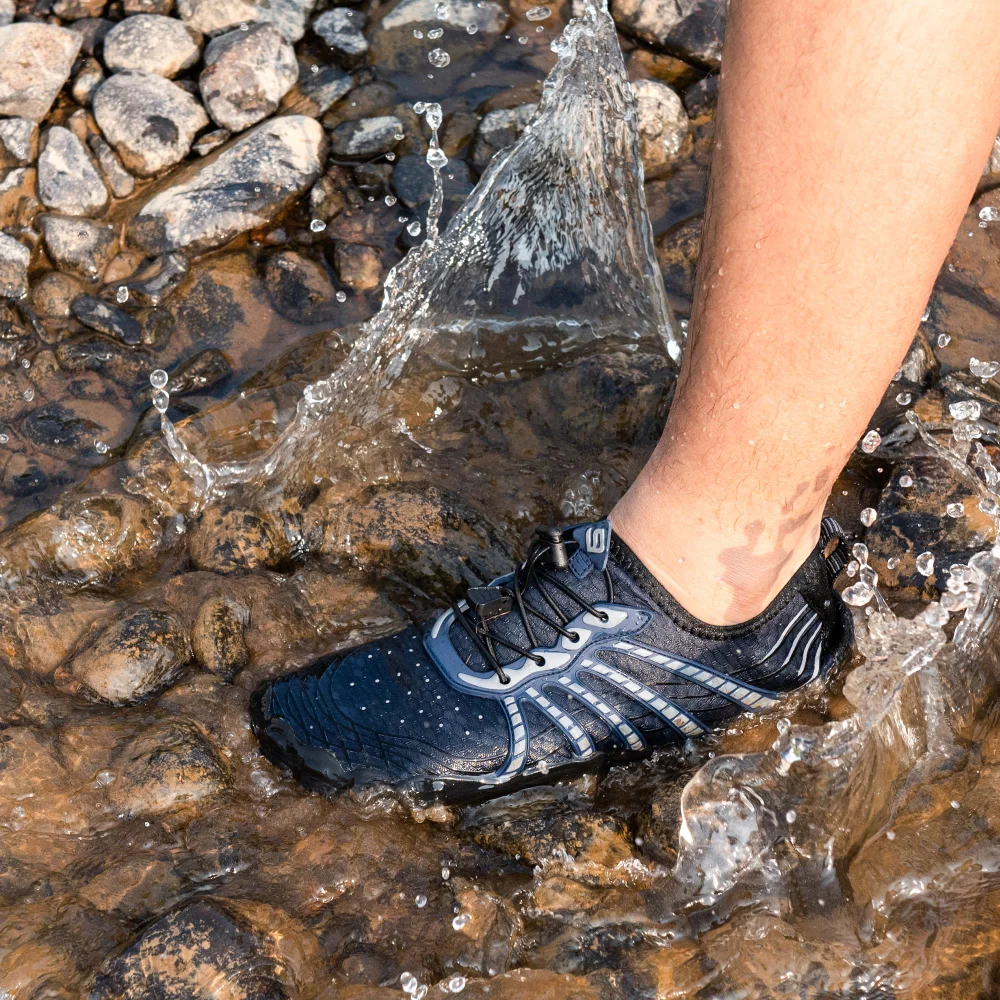
A pool deck, a beach, a tide pool and a river bank all get your feet wet, but each one wants something different from your shoes. At some you slip a pair off and on all afternoon. At others the ground cuts, slides or pulls a loose shoe away. Our two water-day shoes split along exactly that line.
Four wet places, four different jobs
- Pool deck and locker room: get something between your feet and a shared wet floor.
- Sand: a pair you can kick off at the towel and step back into.
- Tide pools and wet rock: grip, and a shoe that will not float away.
- Rivers and lakes: a shoe that stays on underwater and drains when you step out.
Flip-flops do the first two well. The last two call for a water shoe.
The pool deck and the locker room
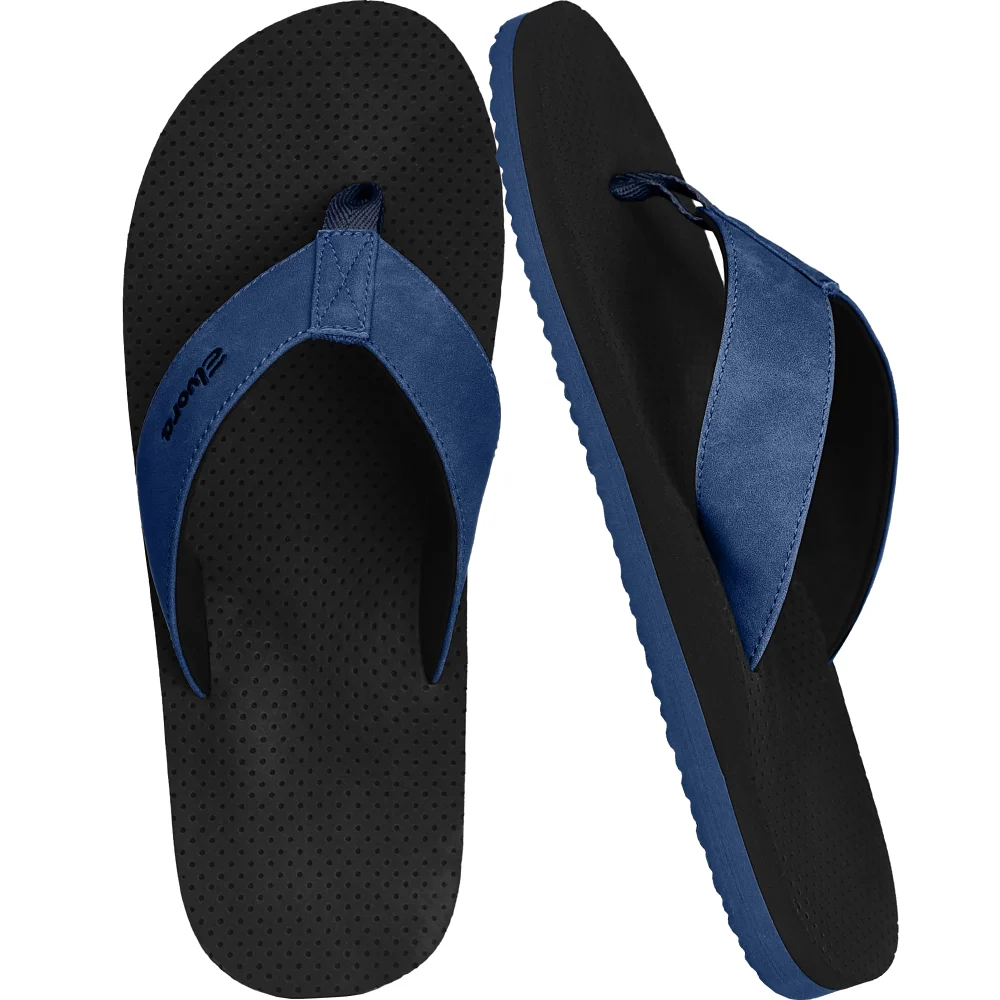
The American Academy of Dermatology suggests wearing shower shoes, flip-flops or sandals around pools, gyms and locker rooms instead of walking barefoot. The American Podiatric Medical Association gives the same advice for pools, beaches and locker rooms.
This is where our men’s flip-flops belong. Both styles sit on the same contoured EVA footbed with a raised arch and a canvas-covered toe post. EVA dries quickly, so a pair that got splashed at the pool is ready again by the time you leave.
The AAD also notes that rubber and plastic shoes make feet sweat more. Let a pair dry between wears, and do not live in it all day.
Sand and the walk to the water
On a beach you step out of your shoes at the towel and back into them for the walk to get lunch. A flip-flop suits that rhythm because it goes on without your hands.
Check the fit before a beach trip. The APMA says a flip-flop should bend at the ball of the foot and never fold in half, and your foot should not hang over the edge. It also warns that even a sturdy flip-flop offers little shock absorption or arch support for long walks. Our footbed has a raised arch, and that does not change the advice. If the plan is a two-mile walk along the shore, wear a closed shoe.
Tide pools and wet rock
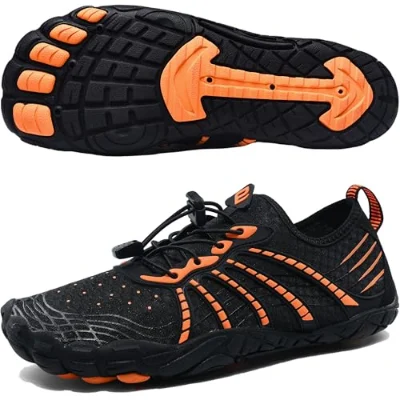
Elvora Barefoot Water Shoe
Water shoe · sizes women's 6 to 15, men's 4 to 13 · 12 colors
From $11.19The rocks are where the choice matters most. The U.S. National Park Service, writing about the tide pools at Cabrillo National Monument, advises shoes with good traction that you do not mind getting wet. It warns that flip-flops and sandals slip off, that bare feet get cut on barnacles, and that algae-covered rock is very slick. Its advice is to walk slowly.
Our barefoot water shoe was built for this kind of ground. It has a rubber sole with deep grooves and a reinforced toe bumper at the front. A stretch mesh upper and a toggle lace hold it closed around your foot. We will not promise that a shoe keeps you upright on algae. Nothing does, and the Park Service’s advice to walk slowly holds in any shoe.
Rivers, lakes and kayak launches
In moving water, a loose shoe is a lost shoe. Pull the toggle lace snug before you wade in. The water shoe has six drainage holes in each sole, so water runs out as you climb onto the bank instead of sloshing around your foot for the next hour.
The toe box is wide and rounded and the sole is flat, with no raised heel. Your toes have room to spread on an uneven stream bed. That is a matter of fit, and we make no claim beyond it.
Sizing a unisex water shoe and a paired flip-flop
Water shoe sizes are printed both ways. The run goes from women’s 6 to 15, which is men’s 4 to 13, and a women’s 9 is a men’s 7. Choose by the size you usually wear, leaving room at the toe as you would in any shoe.
The flip-flops come in paired men’s sizes: 7 to 8, 9 to 10, 11 to 12, and 13. Pick the pair that holds your usual size. Then stand on the footbed and check that your heel does not hang off the back edge.
| Water shoe | Flip-flop | |
|---|---|---|
| Stays on in water | Yes, lace pulls it closed | No, slips off |
| On and off at a towel | Slower | Hands-free |
| Wet rock | Grooved rubber sole, toe bumper | Not for rocks |
| Sizes | Women’s 6 to 15, men’s 4 to 13 | Men’s 7 to 8 up to 13 |
Rinse, dry and store
Salt and sand wear a pair down faster than use does. Rinse both shoes in fresh water after a day at the coast. Loosen the lace on the water shoe so the mesh can dry, and leave flip-flops in the shade rather than on a hot car dashboard.
The APMA advises throwing out worn flip-flops. When the footbed goes flat under your heel or the toe post starts to pull loose, it is time for a new pair.